Last checked: July 24, 2026. This is a non-commercial account-warmup article. It does not include affiliate links, sponsored placements, prices, or purchase CTAs.
An AI agent security checklist for small business should start with one plain question: what can the agent actually touch? If the answer is email, files, payments, customer records, browser tabs, or production systems, the tool is no longer just helping you write. It is operating inside your business.
That does not make agents a bad idea. It does make casual setup risky. Recent guidance from CISA, NIST, OWASP, OpenAI, and Anthropic points in the same direction: give agents narrow access, keep high-impact actions behind human approval, and assume web pages, documents, emails, and tool outputs can carry hostile instructions.
Account-warmup note: Digital Picks Lab is not monetizing this article. No tool is recommended for commission, and no vendor paid for placement. If this page later becomes a buyer guide, affiliate disclosure and fresh product checks need to be added before any commercial link appears.
Last checked: July 22, 2026. This is an account-warmup guide, not a monetized product ranking. There are no affiliate links, sponsored placements, prices, coupons, or purchase calls to action here.
AI agent tools for small business sound exciting until you connect one to email, invoices, CRM notes, or a publishing tool. Then the question gets practical very quickly: what should the agent be allowed to read, what can it change, and where does a human still need to say yes?
No-commercial note: Digital Picks Lab is still in account-warmup mode. This article is educational. If this page later becomes a tool comparison with monetized links, product pages, pricing, permissions, security claims, and disclosures need a fresh check on the publish date.
Last updated: July 19, 2026. This guide focuses on fit, room clearance, and verifiable ergonomics criteria before any product shortlist or purchase recommendation.
Small-apartment chair fit: clearance, support range, and return-policy checks before buying.
If you are comparing best ergonomic office chair for small apartments, start with fit, room clearance, and verifiable ergonomics criteria before chasing a trendy product label. This guide gives a practical shortlist, clear caveats, and the evidence checks to make before choosing a chair.
Editorial note: this article does not include affiliate links, sponsored placements, prices, or commercial CTAs. Check current product pages, return terms, and room measurements before making a purchase decision.
Fiverr vs Upwork for Small BusinessLast checked: June 8, 2026
Fiverr vs Upwork for Small Business is not about picking the more famous freelance marketplace. It is about matching the platform to your scope, risk, timeline, and ability to manage the work.
Short answer: Fiverr is usually better for clearly packaged one-off tasks. Upwork is usually better for custom, ongoing, or collaborative work. Fiverr Pro sits in the middle when you want Fiverr’s buying flow but need a stronger expert filter.
Fiverr tends to work best when the deliverable is easy to describe: a logo concept, a WordPress fix, a short video edit, a product description batch, a simple automation setup, or a defined design task. Upwork tends to fit better when the work is custom, ongoing, collaborative, or hard to package neatly.
The key is not to ask which platform is better in general. Ask which platform gives you the right buying process for this specific project. A quick design task and a six-month marketing role should not be hired the same way.
There is also a third path many small business owners overlook: Fiverr Pro. If a project is too important for a low-context gig, but you still want a marketplace-style buying experience, Fiverr Pro is worth comparing against regular Fiverr Marketplace and Upwork.
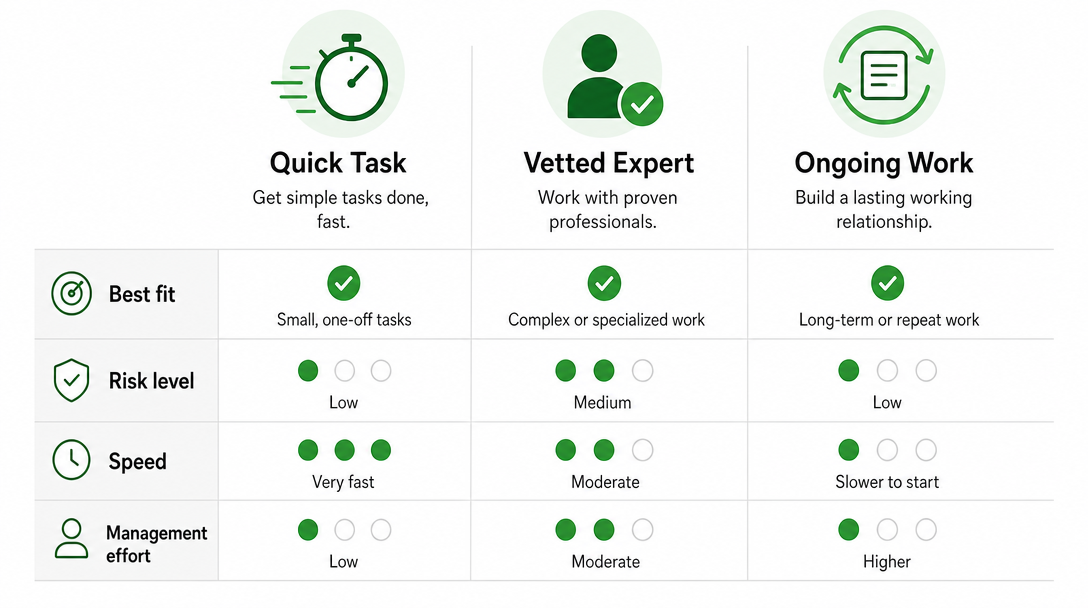
Choose the marketplace based on project type, risk, and how much management the work requires.
Affiliate disclosure: Some links in this article are affiliate links. If you buy through them, I may earn a commission at no extra cost to you. I only recommend a hiring path when it fits the project scenario.
Fiverr vs Upwork for Small Business: Quick Verdict
Project type
Better starting point
Why
A clearly scoped one-off task
Fiverr Marketplace
Faster browsing, packaged services, simple comparison by deliverable
A complex but still defined business deliverable
Fiverr Pro
Better fit when trust and vetting matter more than the lowest price
A long-term role or recurring work
Upwork
Better fit for interviewing, hourly work, longer collaboration, and ongoing management
A quick logo or starter brand asset
Fiverr Logo Maker or Fiverr Marketplace
Good for fast first-draft branding, but check originality and usage needs
A full website build
Fiverr Pro or Upwork
Regular Fiverr can work for narrow tasks, but full builds need stronger screening
SEO strategy or growth work
Upwork, Fiverr Pro, or a specialist agency
Avoid vague "rank fast" gigs; look for audit deliverables and realistic scope
AI automation or workflow setup
Fiverr Pro, Upwork, or a vetted specialist
The brief matters more than the platform because the work can break real operations
Short version: choose Fiverr when the task is productized. Choose Upwork when the relationship is the product. Choose Fiverr Pro when you want a more curated Fiverr path for higher-risk work.
Best next step: Choose the route that matches the risk of your project after reading the comparison.
The best platform changes when the project moves from a packaged task to a managed relationship.
How Fiverr and Upwork Differ for Buyers
Fiverr feels more like shopping for a service. You search a category, compare sellers, read the deliverables, and choose a package or request a custom offer. This makes Fiverr easier when you already know what you need and can judge whether a listing matches it.
Upwork feels more like hiring. You post a job or search talent, review profiles and proposals, interview candidates, and manage the work over time. This takes more effort, but it can be a better fit when the project is not easy to package.
For a small business owner, that difference matters. If you need a YouTube thumbnail template by Friday, Fiverr's productized model may be efficient. If you need someone to manage email marketing every week for six months, Upwork's hiring model may fit better.
When Fiverr Makes More Sense
Fiverr Marketplace is a good starting point when your project has a clear output and a short feedback loop.
Good Fiverr use cases include:
Logo concepts, brand refresh ideas, and simple brand assets.
Video editing for a defined clip length and style.
Product image cleanup, listing graphics, or ecommerce content.
Simple SEO audits with a defined deliverable.
Blog formatting, content repurposing, transcription cleanup, or social media assets.
Small automation tasks where the input, output, and tools are clearly defined.
Fiverr works best when you can describe the project in one page or less. If your brief needs multiple calls, discovery, strategy, and ongoing collaboration, you may need Fiverr Pro, Upwork, or an agency instead.
Use Fiverr Marketplace when:
You can show examples of the style or deliverable you want.
The output is easy to review.
The seller's package clearly matches your scope.
You do not need the freelancer to define your whole strategy.
You can afford one or two small test orders before scaling.
Avoid regular Fiverr gigs when:
The work affects your core revenue system.
You cannot evaluate the deliverable.
The listing promises unrealistic results.
The project requires deep access to your business, customers, or analytics.
You need ongoing ownership and maintenance after delivery.
If Fiverr fits, start with a narrow category or project-specific deep link rather than a broad search. Once your Fiverr affiliate links are available, this is where a category link should go: Browse Fiverr Marketplace
Where Fiverr Pro Fits
Fiverr Pro is worth considering when you like Fiverr's buying flow but the project has higher risk.
For example, a $100 graphic task and a full website rebuild should not be managed the same way. A cheap mistake on a banner ad is annoying. A cheap mistake on your main business website can cost traffic, trust, time, and sales.
Fiverr Pro can make more sense for:
Full website projects.
Brand identity systems.
SEO strategy or technical SEO audits.
Paid ads setup.
Video production for a launch.
AI automation and operations work.
Projects where communication and reliability matter more than getting the lowest possible price.
Fiverr Pro is not automatically the best answer. You still need to check portfolio fit, scope, deliverables, revisions, file handoff, and ownership terms. The point is that Pro can be a better starting filter when a regular marketplace search feels too risky.
If you are choosing between a regular gig and a more vetted expert, compare Fiverr Pro here: Compare Fiverr Pro experts
When Upwork Makes More Sense
Upwork usually makes more sense when the work is closer to hiring a person than buying a package.
Good Upwork use cases include:
Ongoing marketing support.
Virtual assistance.
Custom software or web development.
Multi-week design or content projects.
Strategy and execution roles.
Work where you want to interview several candidates.
Work where hourly collaboration or long-term availability matters.
Upwork is often better when the project is still changing. If you need someone to ask questions, challenge assumptions, and adapt over time, a proposal-and-interview process can be useful.
The tradeoff is effort. Upwork can require more filtering, more messaging, and more project management. If you do not write a strong job post or screen carefully, you can still end up with the wrong freelancer.
Fiverr vs Upwork for Small Business Quality: The Platform Does Not Remove Buyer Responsibility
The most common mistake is assuming quality comes from the platform itself.
It does not.
Fiverr, Fiverr Pro, and Upwork all have strong freelancers and weak fits. Quality depends on your brief, the freelancer's actual experience, how well the project matches their offer, and how carefully you review the work.
For small business buyers, the biggest quality risks are:
Buying a vague gig because it has polished packaging.
Choosing the cheapest option for a high-risk project.
Not checking whether the portfolio matches your industry or style.
Failing to ask what is included and what costs extra.
Giving access before trust is established.
Accepting delivery without testing the files, links, performance, or ownership details.
This is why the right question is not "Is Fiverr better than Upwork?" It is "Can I make this project clear enough that the right freelancer can deliver it?"
Fiverr vs Upwork for Small Business Scenarios
Scenario
Fiverr Marketplace
Fiverr Pro
Upwork
Need a simple logo concept
Good fit
Sometimes overkill
Good if you want a custom designer relationship
Need a full brand identity
Risky unless seller is excellent
Strong fit
Strong fit
Need a WordPress fix
Good fit for narrow fixes
Good for bigger technical issues
Good for ongoing development
Need a full WordPress site
Use carefully
Stronger fit
Stronger fit
Need one video edited
Good fit
Good for polished brand videos
Good if you need an ongoing editor
Need SEO help
Good only for specific audits or cleanup
Better for strategy
Better for ongoing SEO management
Need AI automation
Good for narrow automations
Better for business workflows
Better for custom or ongoing systems
Need a long-term assistant
Usually not ideal
Not usually the main route
Stronger fit
What Real Buyers Often Complain About
Community discussions around Fiverr and Upwork are mixed. Some buyers report useful results, especially for design, content, and defined tasks. Others complain about poor communication, generic deliverables, template-heavy work, missed expectations, or freelancers who appear more skilled in the listing than in delivery.
Treat this feedback as directional, not statistical proof. The pattern is still useful: most bad outcomes are not only platform problems. They are also scope, screening, and review problems.
Common buyer concerns include:
"I do not know if this seller really made the portfolio work."
"The deliverable looks generic or AI-generated."
"The freelancer said yes to everything, then delivered something different."
"The project sounded cheap but extras made it more expensive."
"I cannot tell whether the SEO or website work is actually good."
"I did not know what files or access I should receive at the end."
Your article, job post, or project brief should reduce those risks before you pay.
Buyer Checklist Before Using Fiverr or Upwork
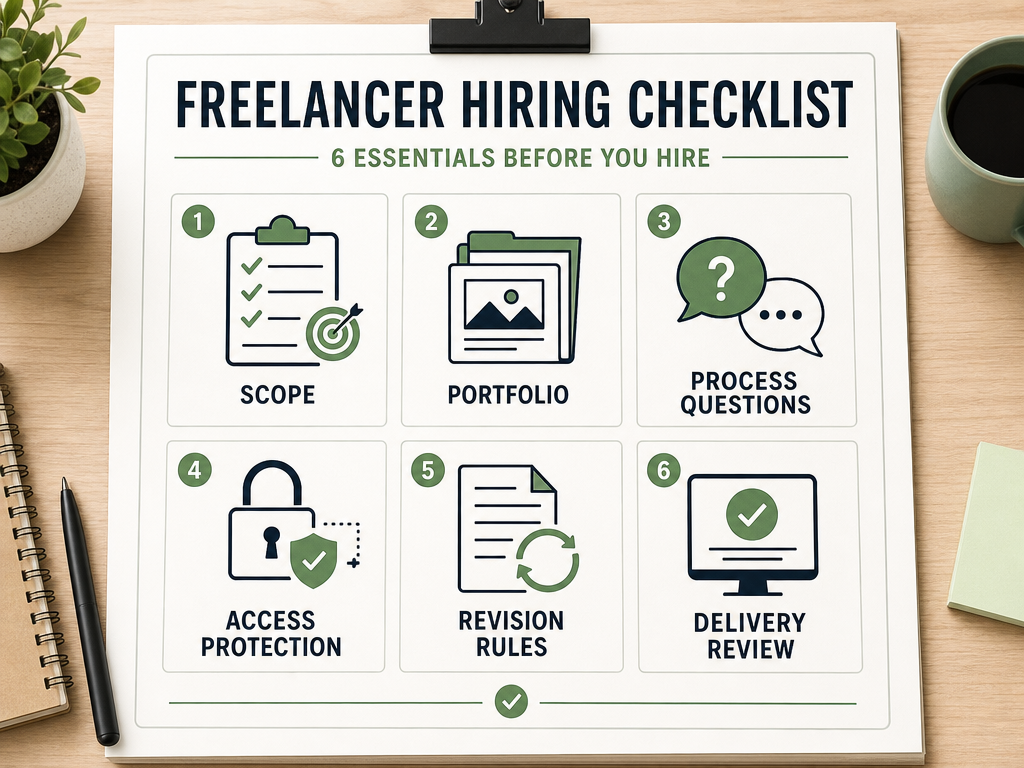
Use this checklist before hiring on either platform.
A strong brief and review process matter more than choosing the cheapest listing.
1
Define the outcome
What exact file, page, setup, report, or deliverable do you need?
What does "done" mean?
2
Choose the right project size
Can this be a small test order?
Is the task too risky for a low-cost package?
3
Check portfolio relevance
Has the freelancer done similar work?
Does the style match your market?
Are examples specific or generic?
4
Ask process questions
What do you need from me?
What is not included?
What happens if revisions are needed?
What files or access will I receive?
5
Protect access
Use limited permissions where possible.
Avoid sharing sensitive credentials casually.
Remove access after the project ends.
6
Review before accepting delivery
Test links, pages, files, speed, forms, tracking, and formatting.
Check that source files and ownership details are included.
Ask for fixes before marking the project complete.
Copyable Project Brief Template
Use this when contacting a Fiverr seller, Fiverr Pro freelancer, or Upwork candidate.
Project goal:
I need [specific outcome] for [business/site/channel].

Context:
My audience is [audience]. The project will be used for [use case].

Deliverables:
- [Deliverable 1]
- [Deliverable 2]
- [Deliverable 3]

Examples I like:
- [Link or description]
- [Link or description]

Style or technical requirements:
- [Brand/style/tool requirement]
- [File format or platform]
- [Mobile/performance/access requirement]

What is not included:
- [Out-of-scope item]
- [Out-of-scope item]

Timeline:
I need the first draft by [date] and final delivery by [date].

Questions:
1. Have you done similar projects? Please share 2-3 relevant examples.
2. What do you need from me to start?
3. What exactly is included in this package/proposal?
4. What files or access will I receive at the end?
5. How do revisions work?
My Recommendation
For most small business owners, the best path is:
Use Fiverr Marketplace for narrow, productized tasks.
Use Fiverr Pro when the task is important, complex, or brand-sensitive.
Use Upwork when you need an ongoing person, custom collaboration, or a longer hiring process.
Do not use any marketplace until you can write a clear brief.
If you are brand new, start with a small test project. Do not begin with your most important website, ad account, SEO strategy, or automation workflow. Hire for one contained deliverable, review the result carefully, and only then scale the relationship.
Best Next Step by Scenario
If you need…
Start here
A fast, defined task
Fiverr Marketplace
A vetted expert for a higher-risk project
Fiverr Pro
A long-term contractor
Upwork
A starter logo
Fiverr Logo Maker or a Fiverr designer
A full website
Fiverr Pro or Upwork, with a strong brief
SEO help
A specific audit first, not a vague ranking promise
AI automation
A small workflow test before a full system
Choose your starting point: Start simple for a defined task, or use a stronger expert filter when the project is important.
Is Fiverr vs Upwork for Small Business an easy decision?
Fiverr is usually better for small, defined, productized tasks. Upwork is usually better for ongoing work, custom collaboration, and projects where you want to interview several candidates. Fiverr Pro is a useful middle path when you want a more curated Fiverr experience for higher-risk work.
Is Fiverr good for website projects?
Fiverr can be good for narrow website tasks such as fixing a WordPress issue, designing a landing section, improving a page layout, or setting up a specific feature. For a full website build, use more caution. Consider Fiverr Pro or Upwork, ask for relevant portfolio examples, and use a detailed brief with performance, ownership, and handoff requirements.
Is Upwork better than Fiverr for ongoing work?
Usually, yes. Upwork is often a better fit when you need a freelancer over several weeks or months, especially for roles such as virtual assistance, development, marketing, or content operations. Fiverr can still work for repeat orders, but its strongest use case is often a clear packaged service.
Is Fiverr Pro worth it?
Fiverr Pro can be worth it when the project has higher business risk and you want stronger trust signals than a regular marketplace search. It is not automatically the right choice for every task. Use it when quality, communication, and portfolio fit matter more than finding the lowest-cost option.
How do I avoid hiring the wrong freelancer?
Write a clear brief, start with a small test when possible, check relevant portfolio examples, ask what is included and excluded, confirm revision rules, protect account access, and review the final deliverable before accepting it.
Should I use Fiverr Logo Maker or hire a designer?
Use a logo maker when you need a fast starter logo and can accept a simpler result. Hire a designer when you need original brand thinking, a full identity system, or work that must feel distinctive in a competitive market. Either way, check usage rights and avoid assuming a low-cost logo is enough for every business.
Final Takeaway
Fiverr vs Upwork for small business is not a platform popularity contest. Fiverr is better when the project can be packaged. Upwork is better when the relationship needs to be managed. Fiverr Pro is worth checking when you want Fiverr's buying experience with a stronger expert filter.
The smartest move is to match the platform to the risk of the project. Buy small, brief clearly, review carefully, and do not outsource a mission-critical task until you know how to judge the result.